
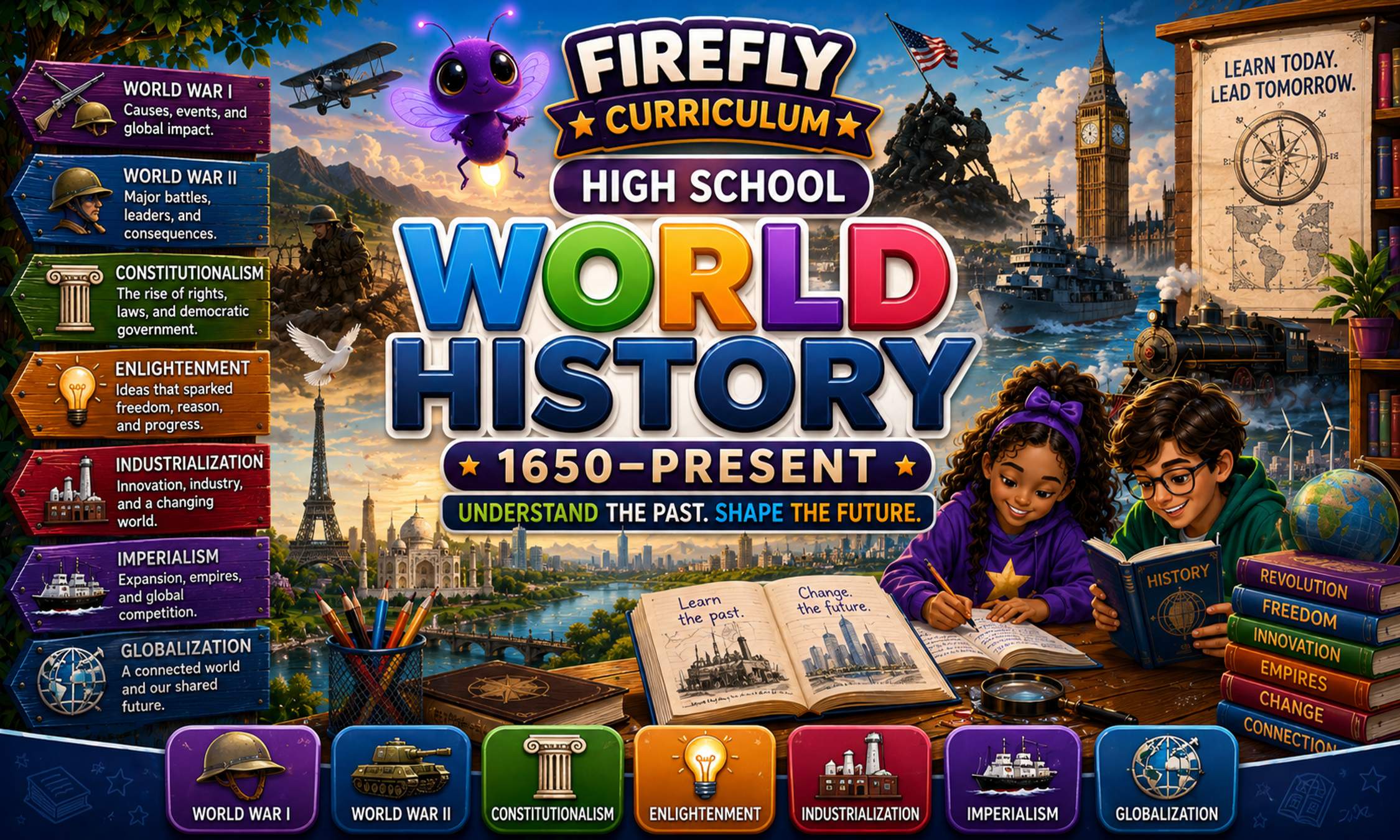



Firefly Curriculum High School World History – 1650 to the Present
WORLD HISTORY
Revolutions, Industry, Empire & the Modern World
Approximately 1650 to the Present
One integrated course · One full high-school World History credit
36 weeks · Five lessons · Nine topics per lesson
Designed for Grades 9-11
Aligned with the C3 Framework and Common Core Literacy Standards for History/Social Studies
Christ → Creation → Order → Stewardship → Wisdom → Dominion
COURSE DESCRIPTION
World History II examines the formation of the modern world from constitutional conflict, Enlightenment thought, and the Atlantic revolutions through industrialization, nationalism, imperialism, the world wars, totalitarianism, decolonization, the Cold War, globalization, and contemporary international challenges.
Students investigate how ideas about liberty, equality, authority, property, class, nation, race, religion, progress, and human rights shaped modern societies.
They study the blessings and burdens of industrial and technological development. They examine how states mobilized economies, propaganda, surveillance, ideology, and military power. They investigate the experiences of workers, families, women, minorities, colonized peoples, religious communities, dissidents, refugees, and ordinary citizens rather than studying modern history only through rulers and wars.
The course is explicitly Christian but historically rigorous. Students evaluate ideologies and institutions according to biblical truth while representing them accurately. They examine injustice within communist, fascist, imperial, colonial, capitalist, democratic, nationalist, and religious societies rather than assuming that one political label removes the effects of sin.
Students analyze primary sources, political cartoons, propaganda, demographic data, maps, treaties, photographs, testimony, speeches, economic arguments, and competing historical interpretations.
By the end of the course, students should be able to construct a sustained historical argument, evaluate political and economic claims, identify warning signs of tyranny, and defend Christian conclusions concerning liberty, responsibility, justice, human dignity, and wise stewardship.
HOW THIS COURSE WORKS
This is one integrated World History course.
Chronology, geography, economics, political philosophy, social history, primary sources, research, writing, Christian discernment, and mastery projects are taught together.
Students will:
• Maintain a modern world timeline.
• Complete recurring regional and thematic map work.
• Analyze primary and secondary sources.
• Interpret political cartoons, propaganda, graphs, and demographic evidence.
• Compare political and economic ideologies.
• Investigate complex causation.
• Study competing historical interpretations.
• Trace continuity and change.
• Develop document-based historical arguments.
• Conduct historical research.
• Participate in debates, mock trials, public forums, and presentations.
• Revise major work toward mastery.
• Apply biblical principles without allowing political preference to replace evidence.
Each lesson contains nine topics. Topics 1–8 develop historical content and skills. Topic 9 provides a cumulative mastery project.
THE CHRISTIAN HISTORICAL INQUIRY FRAMEWORK
Students ask:
-
Truth
What view of God, humanity, morality, history, freedom, and authority shaped this movement or society? -
Order
What institutions created political, economic, social, or cultural order? -
Human Dignity
Who was protected, empowered, excluded, exploited, persecuted, or killed? -
Stewardship
How were property, labor, technology, natural resources, knowledge, and political power used? -
Liberty and Responsibility
What freedoms existed? What moral, legal, and communal responsibilities accompanied them? -
Brokenness
How did pride, fear, greed, envy, racism, nationalism, class hatred, idolatry, or the pursuit of power distort society? -
Faithful Response
Who told the truth, resisted injustice, protected life, created reform, preserved liberty, served neighbors, or remained faithful under pressure? -
Historical Humility
Which conclusions are strongly supported? Which remain disputed, incomplete, or dependent upon perspective?
POLITICAL AND ECONOMIC FAIRNESS
Students learn to distinguish among ideas that are sometimes treated as though they were identical.
Examples include:
• Classical liberalism
• Modern liberalism
• Conservatism
• Nationalism
• Patriotism
• Socialism
• Democratic socialism
• Social democracy
• Marxism
• Revolutionary communism
• Fascism
• Free enterprise
• Mercantilism
• Corporatism
• Cronyism
• Colonialism
• Imperialism
• Constitutional government
• Majoritarian democracy
• Totalitarianism
The course evaluates each according to historical evidence and biblical principles.
Students examine both the creative power and moral dangers of markets, governments, corporations, labor movements, religious institutions, local communities, and international organizations.
CONTEMPORARY HISTORY POLICY
The final lesson should identify a publication cutoff date.
Events after that date should be taught through a clearly marked annual update rather than silently added to permanent historical content.
Students must distinguish:
• Established historical record
• Recent reporting
• Ongoing conflict
• Preliminary interpretation
• Advocacy
• Propaganda
• Unverified claims
Contemporary political questions should be studied with the same sourcing and corroboration required for older history.
 Lessons: