
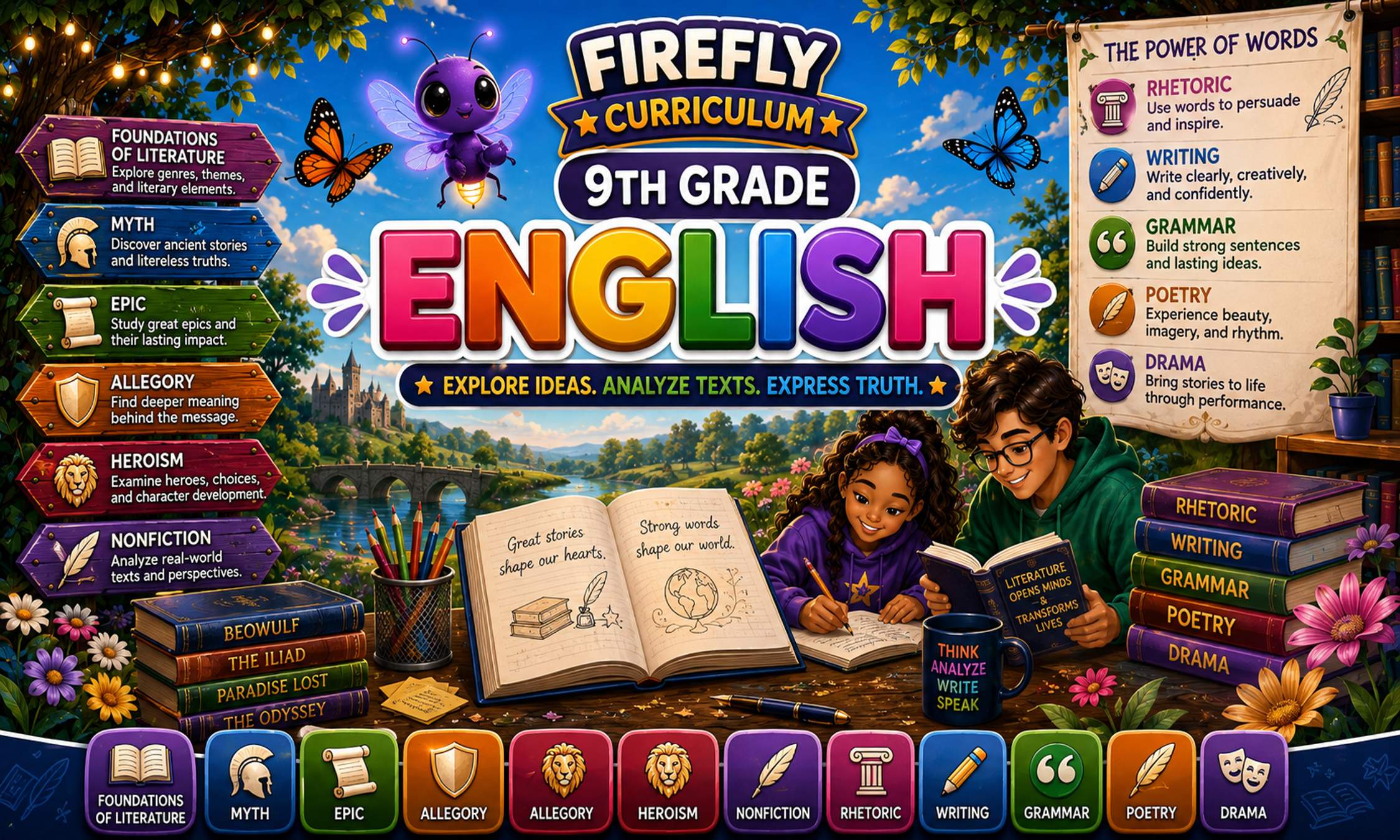



Firefly Curriculum: 9th Grade English
Literature, Writing & Grammar — Full Course Contents
One integrated course · One full high-school English credit
36 weeks · Five lessons · Nine topics per lesson
Aligned to Common Core ELA standards for Grades 9–10
Christ → Creation → Order → Stewardship → Wisdom → Dominion
HOW THIS COURSE WORKS
This is one integrated English course in which students read literature, analyze ideas, discuss texts, write about what they read, and refine their grammar and composition skills at the same time.
Literature provides the ideas, language, characters, conflicts, arguments, and worldview questions students examine. Writing gives students the means to explain and defend their interpretations. Grammar and language study help students communicate those ideas with accuracy, clarity, order, and style.
Students entering high school should already understand the basic purposes of sentences, paragraphs, and essays. Therefore, this course does not treat writing as a sequence of isolated introductory lessons. Instead, students demonstrate and strengthen previously learned skills through authentic literary work.
Throughout the year, students will:
• Write analytical sentences, paragraphs, essays, reflections, comparisons, and arguments.
• Integrate quotations and textual evidence accurately.
• Revise writing for organization, development, clarity, and style.
• Edit grammar, punctuation, usage, and sentence structure in context.
• Participate in discussions, presentations, recitations, and oral defenses.
• Build reading stamina and increasingly independent study habits.
• Apply Christian discernment to literature without reducing every text to a simple moral lesson.
THE FOUR-QUESTION WORLDVIEW LENS
Students use four recurring questions when evaluating literature:
1. What does this text assume is TRUE about God, humanity, and the world?
2. What does this text present as GOOD or desirable?
3. What does this text identify as BROKEN or wrong?
4. What does this text HOPE FOR as a solution, restoration, or final good?
Students compare the text’s answers with a biblical understanding of truth, creation, human nature, sin, redemption, wisdom, justice, mercy, and hope.
The goal is not merely to label a work “Christian” or “non-Christian.” Students learn to identify truth, beauty, insight, error, longing, contradiction, and brokenness with intellectual honesty and Christian charity.
 Lessons: