


Curriculum-shopping season can make even an experienced homeschool parent begin second-guessing everything.
One minute, you are peacefully finishing the school year. The next, you have fourteen browser tabs open, three curriculum catalogs on the table, a half-filled online cart, and a growing suspicion that everyone else knows exactly what they are doing.
They do not.
Most homeschool families are trying to answer the same questions:
Am I choosing the right curriculum?
Is my child working at the right level?
Can I realistically teach all of this?
What will the year actually cost?
How will I keep records?
What am I forgetting?
Will there be room for the subjects my child wants to study?
What happens if our plan stops working?
Those are good questions. But they should not begin with a catalog.
They should begin with the child sitting across from you.
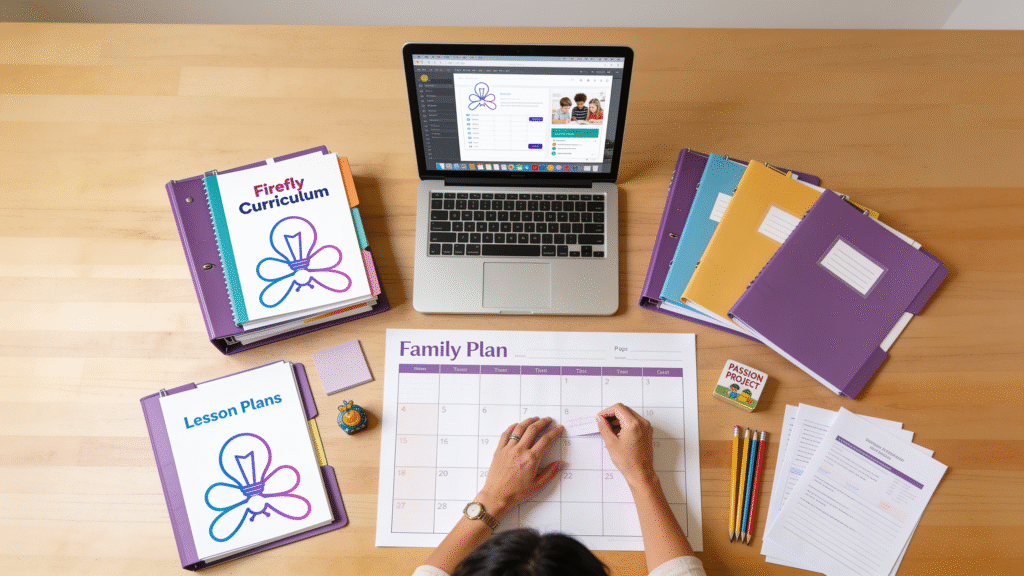
That is why we created the free Plan the Year Around Your Child workbook. Its nine printable worksheets help you move from summer second-guessing to a clear plan built around the children you actually have—not merely the grade levels they happen to occupy.
Once you understand what each child needs, Firefly gives you the tools to build that year: Christ-centered curriculum, flexible subject levels, printable materials, self-paced learning, parent support, academic records, community, and the ability to create interest-based courses when the right elective does not already exist.
The problem may not be the curriculum.
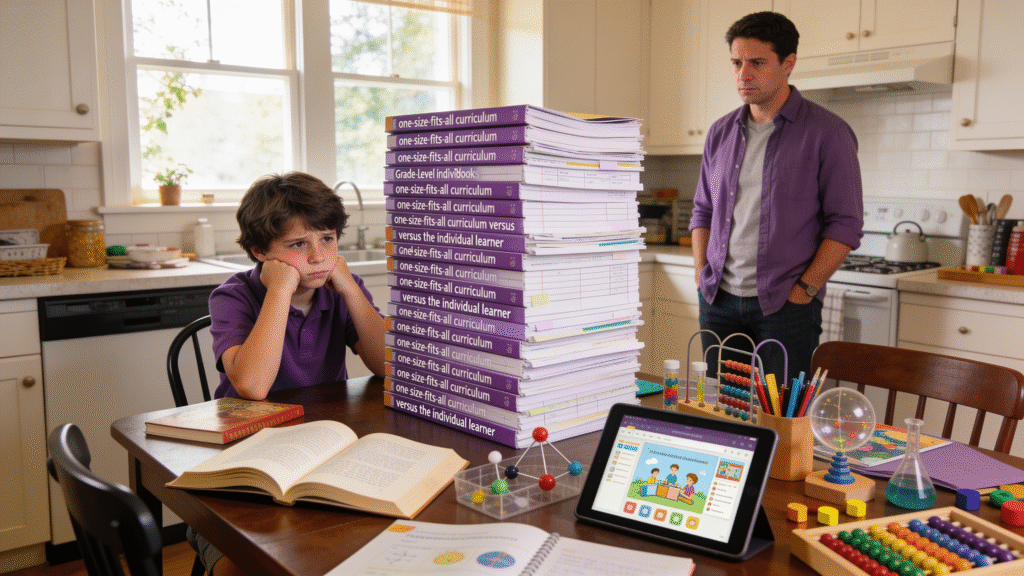
When a curriculum flourishes in one home and fails in another, we often assume one family chose correctly and the other chose poorly.
Usually, the explanation is simpler.
The curriculum was a good fit for one family and a poor fit for the other.
A beautiful, academically strong program may still fail when:
It requires more parent involvement than you can consistently provide.
The format frustrates the child using it.
One grade-level package does not match the child’s actual levels.
The workload overwhelms your family’s schedule.
The program leaves no room for the child’s interests.
The hidden expenses push the year beyond your budget.
Record keeping becomes another full-time responsibility.
That does not necessarily make it a bad curriculum.
It makes it the wrong curriculum for this particular child, parent, or season.
Firefly Education Network was built around this exact problem. Rather than asking every child to fit inside one boxed grade, Firefly allows families to build a different combination of subjects, levels, formats, and support for each learner.
Before you decide what to buy, step back and determine what your coming year actually needs.
1. Decide what your homeschool is protecting

It is easy to build a homeschool year around subjects, assignments, and completion dates without first deciding what matters most.
Begin by naming why you are homeschooling this year.
Your answer may include academic goals, but it may also include:
Protecting family worship in the morning
Giving a struggling learner time to rebuild confidence
Finishing formal lessons early enough to spend afternoons outside
Creating more time for reading aloud
Preparing a high school student for a specific next step
Restoring peace after a difficult school experience
Developing practical skills
Giving a child room to pursue a serious interest
Keeping the year within a firm budget
Now identify two or three things you are unwilling to sacrifice in order to complete a curriculum.
Then name one expectation you are ready to release.
This gives you a filter. When you encounter a lovely program that would consume every afternoon, require more preparation than you can sustain, or crowd out what your family values most, you can say no without wondering whether you have failed.
You are not trying to construct the most impressive homeschool year.
You are trying to build one your family can faithfully live.
How Firefly supports this
Firefly is designed to adapt to your family’s priorities rather than dictate one required daily rhythm.
You can combine:
Printable student workbooks
Online course content
Real books and literature
Self-paced learning
Parent-led instruction
Teacher resources
Live classes
Interest-based electives
One family may use Firefly primarily around the kitchen table with printed pages and read-alouds. Another may rely more heavily on self-paced courses and digital support. Most families will use a combination.
Firefly provides the structure and resources while allowing your family to decide what the school day should look like.
2. Plan for the season you actually have
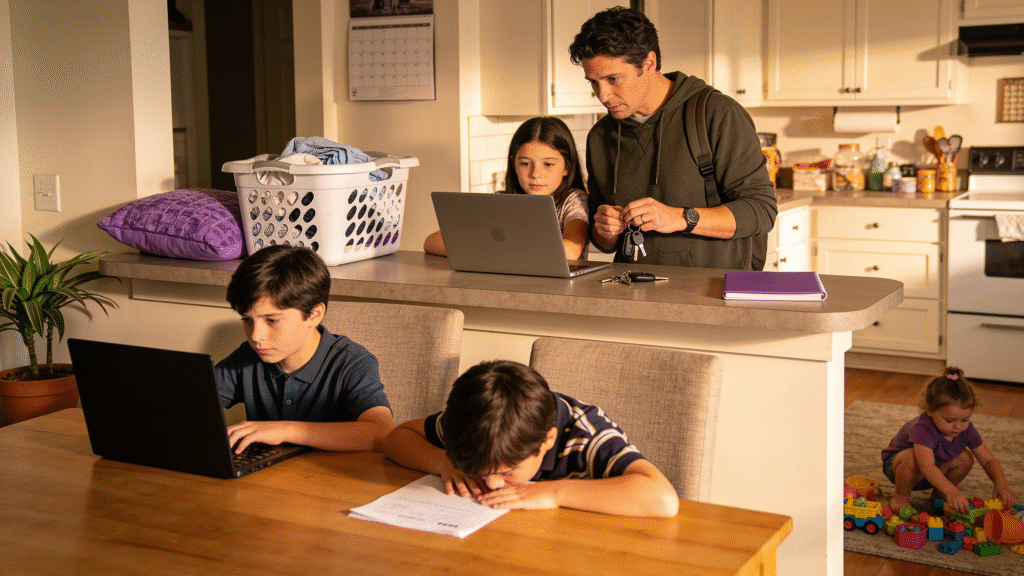
One of the most expensive planning mistakes is choosing curriculum for the season you wish you were entering.
A parent with several uninterrupted teaching hours can use materials that require long discussions, extensive preparation, hands-on projects, and regular direct instruction.
A parent who is also working, caring for a baby, managing health concerns, teaching several levels, or helping an aging relative may need something very different.
Neither approach is more virtuous.
Ask yourself honestly:
How many children am I teaching?
How much direct teaching time can I consistently provide?
Which subjects genuinely need my involvement?
Which children can work independently?
Where would self-paced instruction help?
Which subjects would benefit from outside support?
What major commitments or transitions will affect our year?
Do not build the year around your best Monday in September.
Build it around the ordinary week when someone is sick, the laundry has multiplied, an appointment runs late, and dinner still needs to happen.
A modest plan that reaches May is better than an elaborate plan abandoned before Thanksgiving.
How Firefly supports this
Firefly can be used differently during different seasons without requiring your family to purchase a completely new curriculum.
In a season with more available teaching time, you may:
Teach directly from the printable workbooks
Read literature selections aloud
Lead discussions
Complete projects as a family
Explore additional videos and resources
In a protected-capacity season, you may lean more heavily on:
Self-paced course content
Video-supported instruction
Freddy, Firefly’s built-in learning assistant
Teacher books with worked solutions
Automatic grading and progress tracking
The parent dashboard
You still remain involved in your child’s education, but you do not have to personally deliver every explanation, grade every problem from scratch, or carry every detail in your head.
The workbook’s capacity check encourages families with limited teaching time to prioritize open-and-go, self-paced instruction, teacher support, and automatic record keeping. Firefly is designed to flex between these different levels of parent involvement.
3. Describe each child before assigning a grade level

A child may officially be entering sixth grade while reading at an eighth-grade level, working carefully through fifth-grade math, writing closer to a fourth-grade level, and discussing history like a much older student.
That is not unusual.
It is also one reason a single grade-level package may fit beautifully in one subject and poorly in another.
Before choosing materials, make a short learner profile for each child.
Record:
What genuinely captured the child’s attention last year
What caused tears, avoidance, or daily conflict
Whether the child prefers reading, listening, watching, building, or writing
How much work the child can complete independently
Whether handwriting is easy, slow, or a significant obstacle
Which subjects are ahead, behind, or on level
Which subject you dread teaching
Which subject or interest should be protected
This changes curriculum planning from a comparison between publishers into a comparison between the material and the person who will actually use it.
You are no longer asking only, “Is this program good?”
You are asking, “Will this help this child learn in this home?”
How Firefly supports this
Firefly allows you to customize both the level and the learning format.
For a child who learns best with paper, courses include printable student materials.
For a child who benefits from watching or listening, digital lessons and educational videos can reinforce the material.
For a child who can work independently, self-paced courses provide an organized path forward.
For a child who needs more support, parents can remain closely involved while using teacher books, worked solutions, additional practice, and Freddy.
You do not have to choose between an entirely digital education and an entirely paper-based one. You can use the combination that best fits each child.
4. Choose the level subject by subject
Write down your child’s official grade. Then, beside every subject, write the level at which the child is actually working.
For example:
Subject | Official grade | Level actually needed |
Math | 7 | 6 |
Reading | 7 | 8 |
Grammar and writing | 7 | 6 |
Literature | 7 | 7 |
Science | 7 | 7 |
The purpose is not to label the child as ahead or behind.
The purpose is to identify the level where the work is challenging without being crushing and accessible without being boring.
When the differences are written on paper, curriculum decisions become much clearer.
You may discover that one boxed grade-level package cannot serve the whole child without significant adjustment. You may have to purchase more than one package, discard materials that do not fit, or accept that the child will be bored in one subject and overwhelmed in another.
That does not mean the child needs to be fixed.
It means the plan needs to become more flexible.
How Firefly supports this
Inside Firefly, you select the course level separately for every subject and every child.
A child might use:
Fourth-grade math
Sixth-grade grammar
Seventh-grade literature
Fifth-grade science
An elective chosen around a personal interest
You do not have to purchase two complete curriculum packages and use half of each.
Every available level is included within the applicable family subscription, so placing a child where he or she actually belongs does not require another full curriculum purchase.
The workbook’s Build page asks parents to compare a child’s official grade with the level actually needed in each individual subject. Firefly then allows parents to enroll the child according to those real levels.
In Firefly, an uneven learner is not treated as an exception.
It is the normal way children are built.
5. Use five filters before choosing curriculum.
Once you understand your family and each learner, evaluate every curriculum through five practical filters.
Filter One: Faith
Does the material merely add a Bible verse to an otherwise disconnected lesson, or does its worldview align with what your family believes education is for?
Look beyond labels. Review sample lessons, the publisher’s stated philosophy, and the way subjects such as science, history, literature, creation, and human nature are taught.
How Firefly answers this need
Firefly’s written curriculum is Christ-centered and scripturally aligned throughout the lessons themselves.
Faith is not limited to a decorative verse at the end of a chapter. Biblical truth is woven into the way students understand knowledge, creation, order, stewardship, wisdom, and their responsibility before God.
At the same time, Firefly courses are designed around strong academics and national learning standards.
The goal is not to choose between faith and academic quality. It is to teach academics within a coherent Christian understanding of the world.

Filter Two: Teacher load
How many minutes of direct parent involvement does one lesson require?
Now multiply that by the number of subjects and children.
Also ask:
Is there a teacher book?
Are answers and worked solutions provided?
Can the student eventually complete part of the course independently?
How will progress be monitored?
Who answers a question you cannot answer?
The most important number may not be the curriculum’s price.
It may be the number of parent-hours it requires every week.
How Firefly answers this need
Most students need a parent beside them when they begin a new course. Firefly does not pretend that every child should be handed a login and left alone on the first day.
You help your child get started, understand the structure, and develop a routine.
As the child becomes familiar with the course, he or she can gradually take on more responsibility.
Firefly supports that transition through:
Clearly organized courses
Printable student materials
Teacher books and worked solutions
Self-paced lessons
Freddy, the built-in learning assistant
Automatic grading where appropriate
Progress information in the parent dashboard
Your role begins to shift from personally delivering every piece of content to guiding, supporting, and overseeing your child’s education.
That is not removing the parent.
It is giving the parent better tools.

Filter Three: Learner fit
Does the curriculum match the child you described?
Can it be placed at the child’s actual level instead of merely the child’s age?
Does it come in a format the child can use comfortably?
Can it make room for the topics that genuinely motivate the student?
The right content delivered in the wrong format can still produce daily frustration.
How Firefly answers this need
Firefly gives families several ways to adapt learning:
Select the appropriate level for each separate subject
Print student pages for children who need paper
Use online content for children who benefit from digital access
Include video-supported learning
Add extra practice where needed
Use real books within literature courses
Create interest-based electives when the right course is not already available
Firefly’s AI course generator allows a parent to enter a student’s interest and learning goals and create a structured course in minutes.
A parent might create an elective on:
Horses
Aviation
Marine biology
Baking and kitchen chemistry
Coding
Automotive mechanics
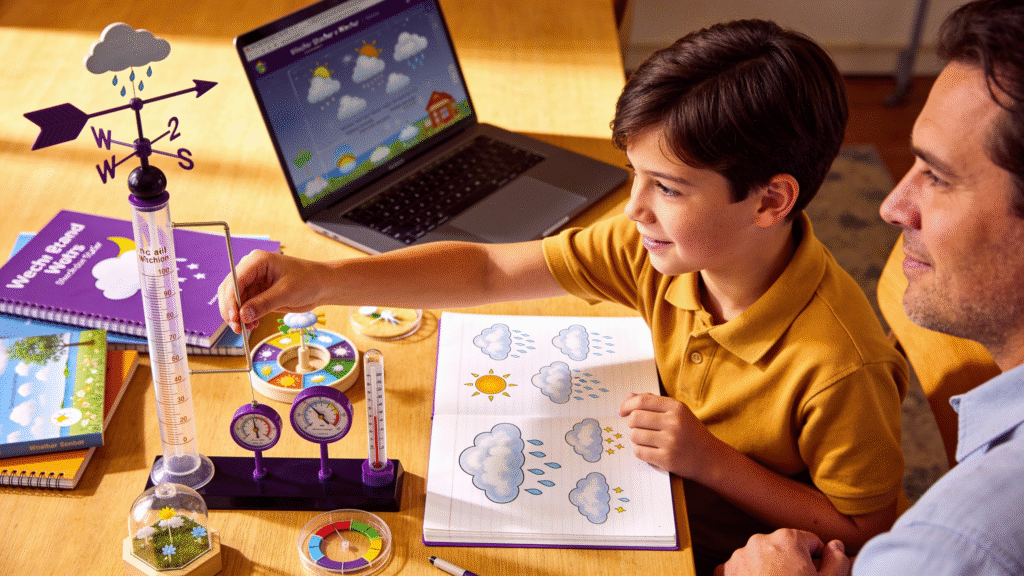
Weather
Entrepreneurship
Ancient civilizations
Drawing or design
The course generator is not intended to replace all of the core curriculum. It gives parents a practical way to turn a child’s curiosity into organized schoolwork without spending weeks building an elective from scratch.
It is one more way Firefly helps the curriculum follow the child.
Filter Four: Season and budget
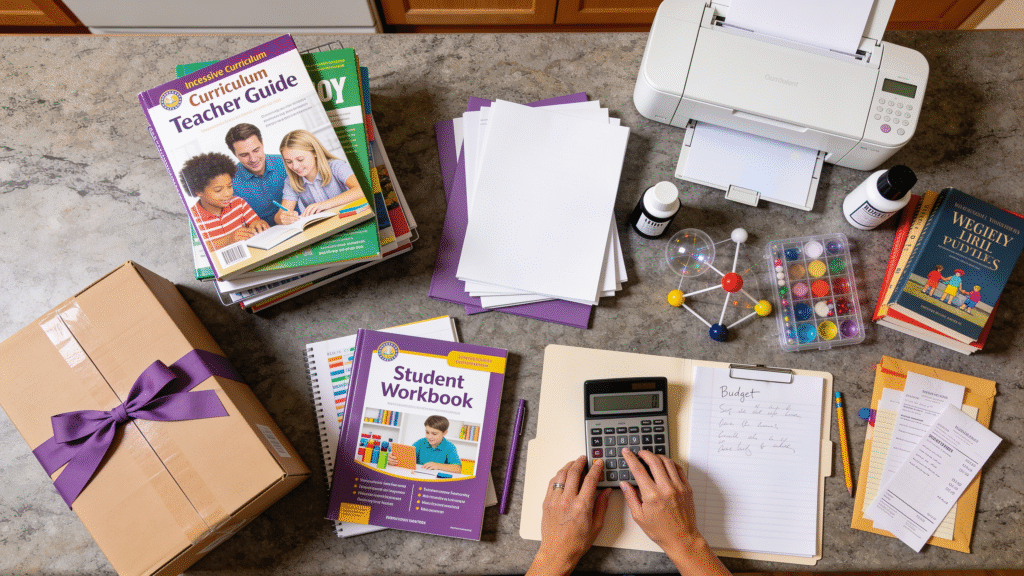
Calculate the full cost of a curriculum, not just the advertised price.
Include:
Teacher guides
Answer keys
Consumable student workbooks
Printing
Science supplies
Literature
Art materials
Shipping
Subscriptions
Co-op fees
Tutoring
Testing
Record-keeping services
Electives and outside classes
Also calculate the cost of changing your mind.
A curriculum that appears inexpensive may become costly when you add several children, multiple subjects, replacement workbooks, outside support, and separate record-keeping services.
How Firefly answers this need
Firefly uses a family-subscription model rather than pricing every subject, course, class, and level separately.
Depending on the family plan, the subscription can include:
Multiple children
Multiple subjects
Flexible course levels
Printable student materials
Teacher resources
Learning support
Academic record tools
Interest-based courses
Community features
Changing a child’s course level does not require purchasing another complete grade-level package.
Adding another included course during the year does not create a separate per-course charge.
Creating an elective around a child’s interest does not automatically become another large item in the homeschool budget.
This makes the cost more predictable and reduces the financial penalty for discovering that a different course or level would work better.
Filter Five: Accountability
What does your state require?
What records will your family need to maintain?
Depending on your circumstances, that may include:
Attendance
Instructional hours
Grades
Work samples
Reading lists
Portfolios
Course descriptions
High school credits
Transcripts
Everyone wants to think about curriculum in July.
Very few people want to reconstruct an entire school year from memory in May.
How Firefly answers this need
Firefly brings curriculum and academic records into the same platform.
Its parent tools are designed to support:
Planning
Progress tracking
Grades
Portfolios
Course-completion records
High school credit documentation
Transcripts
State-specific homeschool information
Instead of maintaining one system for curriculum, another for grades, another for portfolios, and another for transcripts, families can keep the pieces of the year connected.
The records develop as the student works rather than being reconstructed months later.
6. Find the holes in the plan.
Every homeschool plan has gaps.
Peaceful homeschool families are not necessarily the ones who eliminated every gap. They are often the ones who found the gaps early enough to decide what to do about them.
Before finalizing your purchases, ask:
Is there a subject I still have not covered?
Is there a subject I already know I will avoid teaching?
Does one child need a different level from the others?
Is one child ahead in one subject and behind in another?
Who will answer questions when I do not know the material?
How will I handle grades, portfolios, credits, or transcripts?
Do I understand what my state requires?
Is there anything in the plan that excites a reluctant learner?
Where will our family find homeschool community?
Does the plan work only when nothing goes wrong?
The answers become your real shopping list.
You may not need another complete curriculum.
You may need one independent math course, a teacher guide, a record-keeping system, a learning assistant, a community, or an elective that gives a reluctant learner something to anticipate.
How Firefly supports this
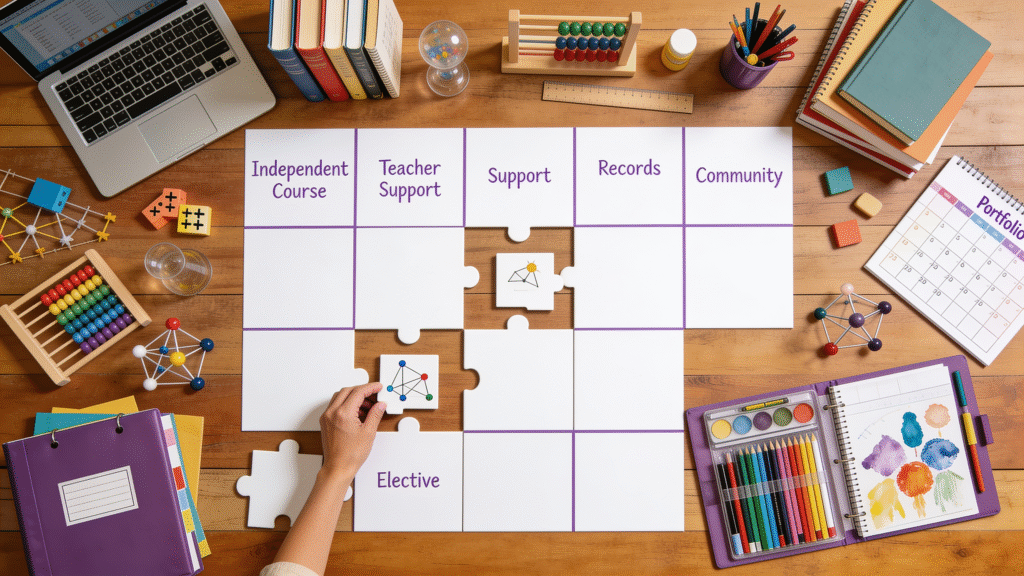
Firefly was built to address the spaces that are often left between curriculum purchases.
The gap in your plan | How Firefly helps |
A subject you have not selected | Choose from available Christ-centered courses |
A subject you dread teaching | Use organized instruction, teacher books, worked solutions, and learning support |
Children working at different levels | Select the appropriate level per child and per subject |
A child ahead in one subject and behind in another | Build that exact combination within the same account |
A question you cannot answer | Use Freddy, Firefly’s built-in learning assistant |
Grades, portfolios, or transcripts | Maintain records through the parent dashboard |
Uncertainty about state requirements | Access state-specific homeschool information |
A bored or reluctant learner | Choose or create an elective around the student’s interests and goals |
Isolation | Connect through groups, forums, live classes, and community features |
A plan that stops working | Change the course, level, or format without buying another full curriculum package |
No platform can remove every difficult day from homeschooling.
But the right platform can keep one difficult day from dismantling your entire year.
7. Make room for the subject your child loves.

Many homeschool children have one topic they cannot stop discussing.
Horses. Weather. Aviation. Engines. Ancient Rome. Marine biology. Drawing. Baking. Coding. Birds.
These interests are often treated as optional because core subjects consume the schedule and budget.
But a child’s strongest interest can become the part of the year that restores curiosity to everything else.
Ask your child:
What would you love to study this year?
What are four or five things you would want to learn about it?
Are there academic skills we could practice through this subject?
What kind of final project would make the course feel real?
What would you like to know or be able to do by the end?
An elective does not have to be frivolous or unstructured.
It can include:
Reading
Educational videos
Research
Written responses
Vocabulary
Experiments
Hands-on projects
Quizzes
Presentations
A final project
Making room for a child’s curiosity is not a distraction from education.
It is one of the privileges of homeschooling.
How Firefly supports this
Families can choose from Firefly’s available courses and live learning opportunities. When a child’s interest falls outside the existing catalog, parents can use the course generator to create an elective based on that child’s topic, working level, and learning goals.
The generator organizes the subject into lessons, topics, activities, assessments, and printable pages, giving the family a structured starting point.
Traditionally, when a child expresses a serious interest, a parent has had to find a specialty curriculum, pay for a separate class, build the course manually, or postpone the idea.
Firefly makes it easier to say yes without turning the elective into another major planning project or purchase.
The workbook calls this the “Spark”: the subject a child keeps asking about and the opportunity to finally make room for it.
8. Put the complete year in one place.
Once you have made the major decisions, consolidate them.
Your plan should show:
Your family’s purpose for the year
Your realistic teaching capacity
The level selected for every subject
Who or what will provide instruction
Which materials need to be printed
How work will be graded or recorded
The gaps you found and how they will be covered
Your estimated budget
The elective you are making room for
Your first day of school
Your midyear review date
A plan is not meant to control every day between September and May.
It is meant to remind you what you decided before the year became noisy.
How Firefly supports this
Firefly helps move your plan from paper into practice.
Once you have completed the workbook, you can use your answers to:
Add each child to your family account.
Select the appropriate level for each core subject.
Choose or create an elective.
Print the student and teacher pages you need.
Organize courses in one place.
Track progress through the parent dashboard.
Maintain grades and records as the year unfolds.
Adjust a course or level when the plan needs to change.
The workbook helps you identify what your family needs.
Firefly gives you a place to build it.
9. Give every curriculum a three-week test.
Do not judge a curriculum entirely by the excitement of the first week.
But do not continue for an entire semester when the same problems appear every day.
After fifteen school days, ask:
Is the curriculum actually being opened?
How long does a real lesson take?
Is the child struggling with the content or the format?
Which subject creates dread before the week begins?
Can the child explain something that was learned?
Can the family sustain this rhythm?
Then make one of three decisions.
Keep it
It is working.
Stop reading reviews, close the extra tabs, and continue.
Adjust it
The foundation is good, but something needs to change.
You may need to:
Shorten lessons
Remove unnecessary repetition
Complete some work orally
Print the lessons
Use video reinforcement
Change the daily schedule
Add extra practice
Provide more parent support temporarily
Release it
The course, level, or format is not working.
Change it without treating the decision as a moral failure.
Curriculum is a tool.
Your child is not.
How Firefly supports this
Nothing in Firefly has to remain frozen simply because you selected it during summer planning.
When something is not working, you can adjust:
The course
The level
The format
The pacing
The amount of printed work
The amount of parent involvement
The elective
The order in which subjects are completed
You are not left with an entire shelf of expensive materials that no one uses.
Changing your mind can cost an afternoon instead of another complete curriculum purchase.
You do not need another beautiful planner that gives you more work to do.
You need a process that helps you make fewer, clearer decisions.
The free Plan the Year Around Your Child workbook will help you:
Clarify your purpose
Measure your honest teaching capacity
Create a profile for each learner
Evaluate curriculum through five fit filters
Set the right level for every subject
Identify the gaps in your plan
Make room for an interest-based elective
Calculate the true cost of your homeschool year
Test your curriculum choices
Create a one-page plan for the year
Print one copy for yourself and an additional learner-profile page for each child.
Set aside about forty-five minutes, use a pencil, and give yourself permission to change your mind.
Plan for the children you actually have, the season you are actually in, and the year your family can actually sustain.
Then build that year inside Firefly
Firefly Education Network was created by a homeschooling family around a simple conviction:
A child is not a grade level.
A child is a particular person with a different pace in every subject, a unique way of learning, individual strengths and struggles, and interests that deserve to be taken seriously.
That is why Firefly brings together:
Christ-centered curriculum
Flexible levels by subject
Printable student and teacher materials
Self-paced learning
Freddy, the built-in learning assistant
Ad-free educational videos
Interest-based course creation
Live classes
Parent planning and record-keeping tools
Portfolios and transcripts
Homeschool community
One family-centered platform
You should not have to force your children into a curriculum box.
Use the workbook to discover what each child needs.
Then use Firefly to assign the right levels, cover the gaps, support growing independence, and build a year around the children God actually gave you.